Rick Perry: The Best Little Whore In TexasThe Texas governor has one driving passion: selling off government to the highest bidder
11/10/11
By Matt Taibbi
Rolling Stone
Copyright 2011
Early morning in a nearly filled corporate ballroom at the Cobb Energy Centre, a second-tier event stadium on the outskirts of Atlanta. It's late September, and a local conservative think tank is hosting a get-together with Rick Perry, whose front-runner comet at the time is still just slightly visible in the bottom of the sky. I've put away five cups of coffee trying to stay awake through a series of monotonous speeches about Georgia highway and port reform, waiting for my chance to lay eyes on the Next Big Thing in person.
By the time Perry shows up, I'm jazzed and ready for history. You always want to remember the first time you see the possible next president in person. But as every young person knows, the first time is not always a pleasant experience. Perry lumbers onstage looking exceedingly well-groomed, but also ashen and exhausted, like a funeral director with a hangover.
In a voice so subdued and halting that I think he must be sick, he launches into his speech, which consists of the following elements: a halfhearted football joke about Texas A&M that would have embarrassed a true fan like George W. Bush, worn bromides about liberals creating a nanny state, a few lines about jobs in Texas, and a promise to repeal "as much of Obamacare as I can" on his first day in the White House.
"I will try," he says, "to make Washington, D.C., as inconsequential in your life as I can."
Then he waves and walks offstage. The whole thing has taken barely 10 minutes.
I can't believe it, and neither can the assembled crowd of Georgia conservatives, who hesitate before breaking into polite applause. I feel like a high school cheerleader who just had her leg jizzed on in the back of a convertible. That's it? It's over? That was Rick Perry's stump speech?
"Low energy, low substance," sighs Justin Ryan, one of the conference attendees. "That's sort of the candidate in general."
But this is America, remember, where one should never underestimate shallow. And Rick Perry brings shallow to a new level. He is very gifted in that regard. He could be the Adolf Hitler of shallow.
Perry's campaign is still struggling to recover from the kind of spectacular, submarine-at-crush-depth collapse seldom seen before in the history of presidential politics. The governor went from presumptive front-runner to stammering talk-show punch line seemingly in the speed of a single tweet, rightly blasted for being too incompetent even to hold his own in televised debates with a half-bright pizza salesman like Herman Cain and a goggle-eyed megachurch Joan of Arc like Michele Bachmann.
But such superficial criticisms of his weirdly erratic campaign demeanor don't even begin to get at the root of why we should all be terrified of Perry and what he represents. After all, you have to go pretty far to stand out as a whore and a sellout when you come from a state that has produced such luminaries in the history of political corruption as LBJ, Karl Rove and George W. Bush. But Rick Perry has managed to set a scary new low in the annals of opportunism, turning Texas into a swamp of political incest and backroom dealing on a scale not often seen this side of the Congo or Sierra Leone.In an era when there's exponentially more money in politics than we've ever seen before, Perry is the candidate who is exponentially more willing than we've ever seen before to whore himself out for that money. On the human level he is a nonpersonality, an almost perfect cipher – a man whose only discernible passion is his extreme willingness to be whatever someone will pay him to be, or vote for him to be. Even scarier, the religious community around which he has chosen to pull his human chameleon act features some of the most extreme end-is-nigh nutcases in America, the last people you want influencing the man with the nuclear football. Perry is a human price tag – Being There meets Left Behind. And sometimes there's nothing more dangerous than nothing at all.Perry shot into the race for the Republican presidential nomination like a rocket, which is to say, he jumped late into a historically underwhelming contest of bumblers, second-raters, extremists and religious loonies, and became the top dog by default simply by virtue of not looking obviously demented at first blush to the national media. At the time, the GOP's Tea Party base was splitting right down the middle, divided between the intellectual libertarians headed by fellow Texan and original Tea Partier Ron Paul, and the "values"-oriented sect steered by the Bible-thumping likes of Michele Bachmann and Rick Santorum. Despite Barack Obama's plummeting approval ratings, Republicans seemed to have little chance of success in 2012 unless someone emerged from the pack with the goods to pull off a seemingly impossible demographic trifecta: capturing enough of these two increasingly insurrectionary camps within the Tea Party to win the primary, while still retaining enough moderate cred to steal the middle from Obama in the general election.
Into this morass stepped Perry, a tall, perma-tanned, Bible-clutching Southerner with front-runner hair and the build of a retired underwear model, boasting 10 years of executive experience and a furious anti-government bestseller (Fed Up!) still sizzling on the nation's bookshelves. This was the magic-bullet candidate, with the End Times connections and born-again beatitude to out-Jesus Michele Bachmann, the CV full of arch-libertarian, anti-Fed ramblings pretentious enough to have been written by Ron Paul, and the eelish good looks to outshine robotic front-runner Mitt Romney. Perry just looked like the inevitable nominee, and it wasn't long before he was sitting atop the polls.
But as a presidential candidate, Perry has mainly distinguished himself with a kind of bipolar wildness in the debates: sullen and reserved one moment, strident and inarticulate the next. He sweats profusely. He can't stand still. When he does manage to get off a zinger, he cracks a smug grin, looking like he's just sewn up the blue ribbon in a frat-house dong-measuring contest. Parts of his record drive the Tea Party nuts, like his decision to pay for the kids of illegal immigrants to attend state colleges just like other students, or his executive order requiring all sixth-grade girls in Texas to be vaccinated against HPV, the human papillomavirus that causes cervical cancer in women.
Liliana Ros, a party committeewoman in Florida, shook Perry's hand during a commercial break at the Orlando debate and promptly finked on him to reporters, offering a pervy description that was missing only the open raincoat and the raging boner. "He grabbed my hand and held on to it," Ros said. "His hand was so cold, like ice. And he was sweating. He didn't seem well, like he was in pain or he was sick or something. I don't know what it was, but something was definitely wrong."
As soon as Perry became that most fragile of early-campaign life-forms, the "presumptive front-runner," opponents and reporters began scrambling to find the skeletons in his closet. The journalism world is abuzz with salacious whispers about his private life, while liberals have focused on his ties to the New Apostolic Reformation, an apocalyptic sect of loopy Christian fundamentalists who think Jesus is coming back soon to blow up the planet.
But voters who want to know who Rick Perry really is would do well to remember the advice of noted political analyst Hannibal Lecter, who instructed Jodie Foster about the serial killer she was tracking in The Silence of the Lambs. What does he do, Lecter asked, this man you seek? He kills women? No, that is incidental. Don't look at what the man does, look at what he is.It's the same with Rick Perry.Yes, Perry has deployed some of the campaign's most extreme anti-government rhetoric, denouncing Social Security as an "illegal Ponzi scheme," calling for the repeal of the federal income tax, even seeming to threaten Ben Bernanke with mob violence if he came to Texas.
And yes, he hangs out with some of the weirdest religious nuts in America, keeping as allies a Texas evangelical who believes the Democrats are literally controlled by a Satanic demon called Jezebel, and another who believes that a recent Perry-led religious rally helped break an ancient curse laid down on Texas soil by Native American cannibals. And sure, yes, he promises to be a more-than-unusually obnoxious belligerent in the culture wars, having appointed three consecutive creationists to head the Texas State Board of Education, signed a law mandating that every woman who wants to get an abortion must first be forced Clockwork Orange-style to stare at a sonogram of the fetus, and executed more prisoners than any governor in modern times.Yes, he has done all of those things, and more. But it's all incidental.
When you ask what Perry's true nature is – the first and principal thing that defines him – there's just one answer: favors.Favors are the one consistent thread running through Perry's political career. Throughout his time as governor, whenever his ideology or his religion comes into conflict with the need to give a handout to a major campaign donor, ideology and religion lose every single time.Though 94 percent of schools in Texas teach a sex-ed curriculum based on abstinence-only – an approach that led one watchdog group to conclude that "shaming and fear-based instruction are the standard means of teaching students about sexuality" in Texas – Perry nonetheless signed an executive order mandating that those same girls subjected to those abstinence-only classes receive an STD vaccine.
You can't talk about STDs to sixth-grade girls, but if it's worth $120 a shot to a pharmaceutical company like Merck, you can jam the birds-and-the-bees lesson right into their arms.Those in Texas who have followed Perry most closely over the years have all come to the same conclusion about him. "He's a cash-and-carry governor," says Craig McDonald, director of Texans for Public Justice, a group that monitors campaign contributions in the state. "He has an extremely strong stomach for holding his nose and doing really dirty favors.""He'll be whatever you want him to be," says one longtime political opponent. "He's all about greed.""There's no line he won't cross," says another."This guy doesn't believe in one damn thing," says a third.As for how this classic, big-government, machine politician – a man who made massive government stimulus routine at a time when Barack Obama was still shooting baskets in the Senate gymnasium – could run as a small-market conservative and Tea Party champion, many in Texas express bewilderment."If you tell a lie often enough, people believe it," says Debra Medina, a Tea Party Republican who ran against Perry in the gubernatorial primary last year. "That's Rick Perry."It's just after midday, a Monday afternoon, and I'm barreling down a stretch of State Highway 176 in the deadest, hottest part of the Texas desert, a few miles shy of the New Mexico border and about an hour west of the rusted oil wells and Friday night lights of Odessa-Permian. Just before I get to New Mexico, I slow down, hang a right and roll down a dirt road, out of America and into a different country.
Rick Perry Country. This is a land neither capitalist nor socialist, but somehow boasting the worst aspects of both systems.The specific spot I'm looking for is a giant hole in the ground – one of the nation's largest repositories of nuclear waste. The facility is run by a company called Waste Control Specialists, the creature of a shadowy billionaire named Harold Simmons, who was one of the single largest financial backers of the Swift-boat campaign against John Kerry, donating more than $3 million.
Chew on that for a moment: The Kerry smear campaign was powered in large part by radioactive waste – or, more specifically, by the fat government contracts to store such waste that were swallowed up by Simmons, a supposedly "anti-government" extremist who, naturally, is one of Rick Perry's biggest supporters.
The Perry-Simmons nuclear landfill is surrounded by giant piles of red clay rising up out of the desert, flanked by huge manmade chasms designed to hold sand-covered drums of sizzling waste. A person entering its gates feels an irresistible urge to wear lead underpants. It's a terrifying sight, but it's even more disturbing as a symbol of Rick Perry's style of government. In Perry's Texas, state regulation doesn't work because regulatory seats can be bought, and the free market doesn't work because connections and influence matter more than competition and performance. The landfill run by Perry's pals at Waste Control Specialists represents an extreme example of both dysfunctional ends of the governor's approach to government, a taxpayer-financed hole in the ground that is as extremely unsafe as it is woefully uneconomic.
"The WCS plant," says Lon Burnam, a Texas state representative, "is the ultimate example of Perry's crony capitalism."Perry's great triumph as governor has been the construction of an elaborate political machine, one that operates according to its own separate dynamic, using donations, appointments and favors as currency.
In fact, Texas is run much like a Soviet protectorate, with a party boss (Perry) and a Politburo of superconnected advisers to the governor who shuffle back and forth between the public and private spheres (Perry's chief of staff, Mike "The Knife" Toomey, for instance, jumped from the governor's office to a job lobbying for Merck prior to the HPV vaccination order), all backed by a somewhat larger Central Committee of big financial donors who are the real "representative" power in the state, much more than the actual state legislature.
Who's on that Central Committee? It's not that hard to figure out. Texas has no limit on individual donations to political candidates, which means the governor's best friends don't have to hide behind soft money and other back-door channels. In Texas, you can pay your tribute right out in the open."The total of hard-money donations to Perry's three gubernatorial campaigns is $102 million," says McDonald, who tracks the state's pay-for-play system on behalf of Texans for Public Justice. "Half of that, $51 million plus, came from just 204 donors."Simmons, the billionaire owner of WCS, is near the top of that list of Perry's 204 super-insiders, having personally donated more than $1 million to Perry's three gubernatorial campaigns. If you add in his donations to the Republican Governors Association, which Perry was elected to lead last year, then Simmons and his company have donated $3 million to Perry-friendly causes in the past 10 years. That makes Simmons the second-biggest donor in Perry's camp, behind the homebuilding magnate Bob Perry (no relation), who has handed over an astonishing $13.7 million to Perry and the governors association.
The system of uncapped donations means that Perry's superinsiders effectively operate as mobsters who hold a chit on the state's government. "These are obscenely huge amounts," says McDonald. "You can give a politician $100 or $1,000 because you like his ideology. But when you start giving him $250,000 or $500,000, you gotta think you are getting something in return."So what did Harold Simmons get for his money? A lot.
For starters, a group of Perry appointees on the Texas Commission on Environmental Quality gave Simmons a license to build his hazardous nuke dump, even after the TCEQ's own team of scientists agreed that the project was too risky, given how dangerously close it lies to the Ogalalla aquifer, which provides drinking water for seven states.When I visit the site in September, it has just rained in the area for the first time in a year – really – and there is water all over the place. Rod Baltzer, the president of WCS, insists that the wastewater is being contained and disposed of in a safe, orderly fashion. But it's hard not to look beyond the dump to nearby Eunice, New Mexico, visible just a few miles away, and wonder about the wisdom of taking a private company's word that there is no contaminated water running underground to the nearby town.
Especially since another of Simmons' companies, NL Industries, has already been caught leaking radioactive waste into an aquifer in Ohio. In a supremely ironic demonstration of how the modern system of payola capitalism works, Simmons is now being paid millions by taxpayers, via the federal Energy Department, to clean up his own mess, moving radioactive waste from his dump in Ohio to the one in Texas.All of this is key to understanding Perry, because the WCS landfill so perfectly fits the business model of his key donors. The company leases the land for the dump, meaning that WCS keeps the lion's share of the profits, while the liability mostly stays with the state. There's no real regulation to speak of, and many of the state's decisions appear to have been greased by massive campaign contributions or other favors: The executive director of the state's environmental commission, for instance, received a job as a lobbyist for WCS not long after helping the firm get its license.What's more, the company even got the government to pay for the landfill, lobbying the town of Andrews to float a $75 million bond issue to finance the construction of two new dump sites on the property. And in a final insult, WCS managed to negotiate a loophole exempting it from having to pay school taxes in Andrews. Instead, it offers a few small scholarships a year.
"When I was a kid, our high school was the first one in Texas to have carpets," says Melodye Pryor, a local resident and longtime opponent of the dump. "Now, our schools are falling apart."
Andrews is little more than a few crisscrossed roads in the middle of the desert, wrapped around a couple of gas stations and Mexican restaurants and populated by tough blue-collar workers hunkered down in modest little sun-cooked houses.
If you can grasp this little working-class neck of Texas lending a Dallas billionaire $75 million so that he can keep 90 percent of the revenue from a dangerous nuclear-waste dump that runs without any real regulatory oversight, all while paying no school taxes, then you've begun to understand what Rick Perry's America might look like."It's the worst possible hybridization," says Medina, the Tea Party candidate who ran against Perry. "A private entity keeps the receipts. The state and the taxpayer own all the liability."The descriptions of Perry's early political career all sound like the early chapters of true-crime books about serial killers, where nobody notices anything special about the protagonist until the bodies start piling up along the local riverbank. In Perry's case, those bodies didn't start showing up until 2000, when Bush became president and
Perry assumed his seat as governor, turning the state government into a factory of obscene backroom deals. At first, like many of today's would-be Tea Party leaders, Perry started off trying to milk big government rather than dismantle it. In the late Eighties, when Michele Bachmann was training for her future as an anti-tax crusader by working for the IRS, Perry – who like Bush had a military pilot's background, but unlike Bush flew in the real Air Force for five years – was serving in the Texas state legislature, representing Haskell County, a dry little pocket of nowhere just north of Abilene and west of Dallas.
While Bush made a great political career pretending to be a hick Texas rancher, Perry started out as the real thing, a cotton farmer and cattle rancher who spent his early adulthood looking for a way out of life on his dad's farm. "He was ranching with his family," says Fred McClure, a former aide to Sen. John Tower who met Perry in 1978. Perry had come to Washington to observe the American Agricultural Movement, a grassroots campaign launched by farmers to get the federal government to raise farm subsidies. Though the movement was the ideological opposite of the Tea Party, begging for government handouts, Perry knew a political opportunity when he saw it. "This was an early indicator of his ability to evaluate politically what was going on," says McClure, who remains friends with Perry today. "The grassroots nature of the American Agricultural Movement was not unlike the grassroots nature of the Tea Party. He developed the skill set to read the political tea leaves." It was after watching the angry farmers descend on Washington that Perry decided to run for the state legislature. "I think part of it was that he was bored farming in Haskell," McClure says.
Perry's early political career was marked most particularly by a seeming lack of ambition to accomplish anything specific. After being elected to the Texas House in 1984, he told a newspaper in Abilene, "I had not one piece of legislation I planned to carry." When the state land commissioner asked him to sponsor a bill, Perry told the commissioner not to bother explaining it. "I wouldn't understand it anyway," Perry said.Back then, the future global-warming denier was a Democrat, and even supported Al Gore for the presidency in 1988.
But with Texas moving to the right, Perry switched parties the following year – not for ideological reasons, it appears, but because he could sense the wind shifting. "Perry is a really, really good politician," one Republican strategist later explained. "He understood where the state of Texas was going." The move also enabled Perry to defeat Jim Hightower, a popular Democrat, as agricultural commissioner, a powerful post in America's second-biggest farm state. During his two terms in the office, Perry demonstrated little ideological bent, even expressing support for Hillary Clinton's health care plan in the early Nineties. In 1998, Perry was elected lieutenant governor alongside George W. Bush, serving with the kind of distinction that made his boss look like Winston Churchill. Perry reportedly zoned out during a series of breakfast meetings that Bush held with top Texas politicians. "Sometimes, to pass the time, he would file his nails," The New Republic reported.
Bush and Perry reportedly had a chilly relationship, thanks in part to Bush's refusal to let Perry test the limits of political nepotism. In 1995, Perry wanted to nominate his brother-in-law, Joseph Thigpen, to the 11th Court of Appeals. Bush blocked the move, and legend has it that Perry blamed Karl Rove for the incident and never forgave either of them. This might help explain in part why Perry was so eager to start packing the state offices with cronies the moment Bush left for Washington.Perry's prowess in building his political machine at the expense of taxpayers can be tied directly to his administration's almost mathematical precision in making government handouts match the campaign contribution. "There are a couple of things you need to do if you want to raise obscene amounts of money," says Andrew Wheat, research director at Texans for Public Justice. "One, you need to send the message that you're carefully counting who's giving how much, to create a competitive atmosphere. And two, you want to send not-so-subtle signals that there's going to be a return on the investment. And this governor has been a master of sending those signals."How masterful has he been? According to Texans for Public Justice,
Perry appointed 921 of his donors and their spouses to government posts over the past decade. All told, those appointees gave a staggering $17 million to his campaigns – 21 percent of the entire amount he raised during that time. To give an indication of just how completely for-sale public appointments became during his administration, Perry collected $6.1 million from the 155 people he appointed to be regents of state universities in Texas.You can get a fairly decent summary of Perry's track record as governor just by going down the list of political favors that were granted to the 204 "Central Committee" members who collectively contributed half of his campaign money. Start at the top: Perry's biggest single donor, the homebuilder Bob Perry, was rewarded with his very own regulatory agency.
Back in the Nineties, Bob Perry made a fortune building cheap homes, and he had enormous success in circumventing regulation, taking advantage of arbitration clauses that prevented homeowners from suing in the event of leaks or faulty construction or other problems. But after he lost a high-profile arbitration case, he and other builders decided to go straight to the top. In 2003, his company's general counsel, John Krugh, served on a task force established to craft new legislation. The result was a bill creating the Texas Residential Construction Commission, which Gov. Perry signed into law that year. Not long after getting a $100,000 check from Bob Perry, the governor appointed Krugh to serve on the new nine-member commission.
The commission, which initially included four builders and not a single consumer advocate, was a masterpiece of deregulation – actually a kind of deregulation from within, in which builders created and ran a toothless regulatory agency to non-police themselves. The body forced homeowners to pay, at minimum, hundreds of dollars for an inspection fee before making any complaint against a builder. And though the commission frequently ruled in favor of ripped-off homeowners, it had no enforcement power at all – meaning homeowners rarely got their homes fixed.
Perry's entire career as governor is marked by a history of similar handouts to his top donors. In 2005, he signed an executive order to speed approval for 17 new coal-fired power plants that would drive the state's carbon footprint past that of Florida, California and New York combined. Eleven of the plants were slated to be built by TXU, a million-dollar donor.
Then there was the chicken-farming king Lonnie Pilgrim, who once handed out $10,000 checks on the floor of the Texas legislature in advance of a bill; he gave more than $600,000 to the governor and his causes, and Perry repaid the favor by petitioning the EPA for a waiver of federal ethanol mandates, which had jacked up the price of corn feed for Pilgrim's business.
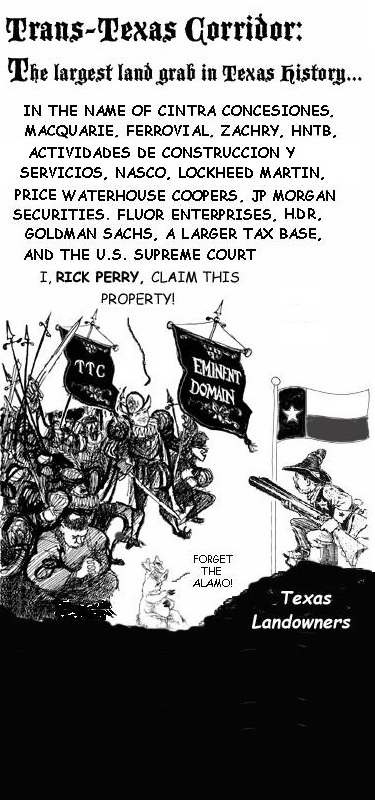
Perhaps the single most interesting favor that Perry doled out is one that directly violated his supposedly "conservative" Tea Party principles. One of his first big moves as governor was to back the Trans-Texas Corridor, a $175 billion project to privatize the state's highways. This was to be the mother of all public-works projects, a 4,000-mile highway network, at some points four football fields wide, that would also include commuter rails, freight rails and telecom pipelines. The TTC, in essence, was the ultimate Tea Party nightmare, a massive public boondoggle that would have created a huge network of new tolls and required a nearly unprecedented use of eminent domain to help the state seize nearly 500,000 acres of land from ranchers and farmers.Though most of the project was shot down by the state legislature, Perry did manage to push through several parts of it, most notably a few stretches of new highway construction around Houston and Dallas. Some of the beneficiaries of those projects were American firms that had donated lots of money to Perry and the governors association, like Williams Brothers Construction ($621,000), Parsons Corporation ($410,000) and JP Morgan Chase ($191,000). But another beneficiary was a Spanish firm called Cintra, part of a consortium that won the development rights for the original TTC project.Cintra's involvement was an obvious case of revolving-door politics. A Cintra consultant named Dan Shelley left private practice in 2004 and joined the Perry Politburo that same year, working as the governor's legislative liaison during the time Cintra was in line to win the multibillion-dollar project. A year later, Shelley went back to private practice, earning more than $50,000 in consulting fees from Cintra once he left "public" office.Cintra ultimately received about $5 billion in contracts from the state to develop three major highway projects, one of which, a toll road in central Texas, is one of the few surviving remnants of the hated TTC. On another Cintra highway, the North Tarrant Express near Fort Worth, the state ponied up $570 million to subsidize the project and permitted Cintra to recoup its investment by building toll lanes for drivers who want to bypass the free lanes. That means future generations of Texans who are in a hurry to get somewhere will have the pleasure of being able to jump on a toll lane they already paid taxes to help build. It turns out you can mess with Texas after all.That's if the road ever gets finished. Cintra received a similar contract to run a toll road in Indiana, but it soon ran into financial problems and had to jack up tolls to pay for the $3.8 billion project. In Texas, Cintra will have some latitude to raise rates on its roads, and if you don't like it, well, fuck you. "What are we going to do – go complain to a board in Spain?" says Terri Hall, founder of an advocacy group called Texans Uniting for Reform and Freedom that fought the highway deal.In addition to the highway contract with Cintra, Perry this year signed a bill written in part by a lobbyist for a British firm called Balfour Beatty, paving the way for the state to sell virtually everything that isn't nailed down to anyone – foreigners included. The bill, Hall says, allows "all public buildings, nursing homes, hospitals, schools, ports, mass transit projects, telecommunications, etc. to be sold off to corporations."
Even more incredibly, the bill authorizes companies to borrow money from the state, which will also help secure their debt. In other words, Perry passed a bill under which a foreign company could theoretically borrow money from Texas taxpayers to buy the taxpayer's own state property back from him, at a discount!But the most treasonous Perry deal of all came when he tried to do a macabre favor for his political hero, former senator Phil Gramm. Gramm gave hundreds of thousands of dollars to Perry's campaign, essentially emptying the remnants of his own campaign war chest into Perry's when he left public office and went to work for the Swiss bank UBS.
In 2002, Gramm came to Perry's administration with a proposal that would allow the bank to take out life insurance policies on retired Texas teachers. Under the deal, UBS would collect on the policies of the teachers when they died, and reward the state with a small cut for arranging the wagers. Teachers who balked at letting UBS profit from their death were reportedly to be paid $100 to sign on the dotted line. The state insurance commissioner, a Perry appointee, approved a special waiver to allow the deal to go through, but the project collapsed after a media backlash.To recap, Rick Perry:- Sold the right to tax Texas highway drivers to Spanish billionaires;
- Let a British firm write a law authorizing the sale of virtually all Texas state property to foreign corporations, and
- Tried to literally sell the lives of retired Texas schoolteachers to a Swiss bank.
Yet he's somehow built a reputation in the national media as a fist-shaking America-first nativist, with a Tea Partier's passion for small government. How Perry has managed to sell this fictional version of himself is a testament to the extraordinary power of marketing over reality in our modern political system. In fact, his entire career is a profound testament to our nagging collective inability, or perhaps unwillingness, to distinguish between what a politician says and what he actually does."People are like, 'He wears a red shirt, he must think like I do,'" says Medina, Perry's Tea Party opponent. "It's 'you're Christian, I'm Christian, we must believe the same.'"
For a long time, perry masterfully exploited this basic weakness of the American voter. As he prepared his run for the White House, he took loud and drastic steps to plant flags in both of the main camps of the Republican Party base, making sure there was an extensive record of Tea Party-friendly remarks attached to his name, as well as lots of file footage of him cozying up to prominent evangelicals. He accomplished the former task mainly through his book, Fed Up!, an impressively shameless volume of avalanching self-congratulatory horseshit that lays the indignant Tea Partyisms on so thick, one imagines Perry wearing a tricorner hat as he dictates to his ghost writer. "We are tired of being told how much salt we can put on our food, what windows we can buy for our house, what kind of cars we can drive," Perry writes. "We are fed up with bailout after bailout and stimulus after stimulus... the government picking winners and losers based on circumstance and luck."
Nowhere in the book, of course, does it mention that Perry, who famously refused Obama's stimulus money and blasted the administration for reckless borrowing and creating "zero jobs," greenlighted two gigantic stimulus programs of his own. Both the $200 million Emerging Technology Fund and the $363 million Texas Enterprise Fund were little more than crude vehicles for repaying campaign donors with state aid. The state has also given millions in handouts through the Texas Film Commission, paying for TV commercials for Fortune 500 firms like Walmart.Perry, who consistently criticizes Obama for borrowing to pay for his stimulus, even paid for the Texas Enterprise Fund in part by borrowing $161 million from the state's unemployment insurance fund – meaning he took money from the paychecks of blue-collar workers and turned it into millions in welfare grants for companies like Lockheed Martin, Texas Instruments and Hewlett-Packard. Ironically, Texas is now running out of money to pay for unemployment claims – including those laid off by companies receiving grants from the Texas Enterprise Fund.But despite the fact that Perry does a lot of exactly what he decries in his book, there are still plenty of Tea Partiers who profess fierce loyalty to him. The odd thing is that while being uncompromising and morally absolutist is normally one of the key features of the entire Tea Party movement, some of the same true believers who were willing to risk a national default rather than borrow one single dollar over the debt limit suddenly become long-view-taking pragmatists when it comes to Perry. "Ideology is wonderful in principle," says Toby Marie Walker, a Tea Party leader in Waco, sounding more like Barack Obama than John Birch. "But it's not practical in politics."
Walker says she gives Perry credit for changing course when there was a public outcry over some of his less-than-classically-conservative policies – including his use of eminent domain (he later signed a bill restricting it) and his HPV vaccine order (which he has since renounced as a "mistake"). Admitting your mistakes, says Walker, is "valuable to have in a leader."
When I point out that Perry essentially repeated the same "mistake" this year, signing a bill mandating shots of a meningitis vaccine (made by Novartis, a $700,000 donor) for every college freshman in the state, Walker suddenly changes tack and defends the move as good policy. "You can opt out of a shot – you cannot opt out of meningitis," says Walker, joking that I'm giving the governor a hard time for forcing people to avoid cancer. When I ask how that is any different from Obama forcing people to buy health insurance, she again points to the "optional" nature of Perry's executive orders. "I can't opt out of Barack Obama's health care plan," she says.
In point of fact, students can "opt out" of Perry's vaccines only if they obtain a conscientious-objection form from the Texas Department of State Health Services, and renew it every two years – which, if nothing else, is an entertainingly surrealist take on the Tea Party doctrine of limited government.In any case, my discussion with Walker is predictably pointless. When I ask about Perry selling stretches of already-paid-for highway to foreigners, Walker replies, "We need another road." When I ask about Perry trying to force Texans to pay tolls to an unaccountable Spanish corporation, the answer is, "I don't have a problem paying for upkeep."When you start hearing Tea Partiers say they don't mind paying taxes, you know the matter has exited the realm of the logical. Medina, who took an impressive 18 percent of the vote in her primary race against Perry, says some Republican voters are so focused on beating Barack Obama that they can't see the truth about a big-government machine politician like Perry.
"You have to want to know," she says. "And it's easier not to."As befits any Texas politician, Perry has always been at least superficially religious, growing up in the same Methodist tradition as George W. Bush. But like his relatively late conversion to extreme anti-tax/Tea Party rhetoric,
Perry's decision to throw in with the truly loony sect of evangelicals only came very recently, after a prayer meeting with two crazy-ass pastors, Tom Schlueter of Arlington and Bob Long of San Marcos, in his office in 2009. According to The Texas Observer, Schlueter had received a "prophetic message" the day before this visit from a local Christian soothsayer named Chuck Pierce, instructing him to "pray by lifting the hand of the one I show you that is in the place of civil rule." Meaning Perry, apparently.The governor bought the act, paving the way for his impressive slate of primary-season pandering to evangelicals this year. The big ploy was an early-August stadium God-tacular called "The Response," in which Perry invited Christian leaders – featuring a heavy concentration of Rapture merchants and End Timers – to pack into Reliant Stadium in Houston to read the Good Book and "respond" to wayward America's departure from proper Christian values. Perry surely scored points with evangelicals everywhere by brazenly using state resources to promote the event, which his office unironically described as "a nondenominational, apolitical Christian prayer meeting." And his performance in front of the crowd of 30,000 evangelicals was strong stuff. He smiled through his perfect tan and repeatedly clasped his hands together for rhetorical emphasis as he read from the Book of Joel: "Return to me with all your heart, with fasting, weeping and mourning!"
The choice of reading was no accident, as the Book of Joel is very popular with the two preachers who shared the stage with Perry that night, Alice Patterson and C.J. Jackson, both bigwigs in the extremist movement known as the New Apostolic Reformation. In fact, followers of NAR sometimes refer to themselves as "Joel's Army."
They believe Joel describes how God is coming back to set up a "kingdom on Earth" with a church that will be "organized more as a military force with an army, navy and air force," to dispense justice and set shit straight with all of us nonbelievers before the second coming of Jesus.NAR literature dwells endlessly on the need to conquer the so-called "seven mountains" of earthly culture, including the media, Hollywood and Congress, so all the Democrats and relativist comics and other satanic forces can be purged on time before the Great End. These people are completely nuts, and quite obviously expect Perry to start filling the cattle cars for them as soon as he gets elected.Watching Perry addressing the crowd, several questions naturally came to mind. One was, "Does he really believe this stuff?" But another one was, "Would it matter if he did?" After all, there are times in life when insanity is indistinguishable from cynicism.
A man who will take money to greenlight a dangerous nuclear-waste dump that might blow up 30 years from now is not much different from the guy who doesn't balance his checkbook because he thinks Armageddon is coming before the end of the quarter. In both cases, the long view doesn't matter.That is why Rick Perry is so dangerous. He represents the ultimate merger of nihilistic short-term corporate calculation and rightist apocalyptic extremism. He is a politician willing to do absolutely anything for a buck today, playing to a demographic of millions willing to walk off a cliff en masse tomorrow. In a Rick Perry White House, there will not be much planning for a rainy-day future.
Perry's run for the White House as a small-government Tea Party conservative is one of the all-time great marketing scams, a breathtaking high-wire act by a man who if nothing else certainly has the gigantic balls required for the most powerful job in the world. But it's an act that should have ended after just a few steps down the rope, when he slipped up in the Orlando debate and told the truth.Among other attacks that night, Perry was taking criticism for his decision back in 2007 to order all sixth-grade girls in Texas to be inoculated against HPV – specifically, with three shots of Gardasil vaccine, a Merck product that sells for a tidy $120 a shot. Michele Bachmann, who not only hates the move as an intrusive use of state power but probably also because it interferes with God's ability to administer punitive cancers to dabblers in extramarital sex, blasted Perry for delivering such a blatant favor to his corporate buddies at Merck.
"We cannot forget that in the midst of this executive order, there is a big drug company that made millions of dollars because of this mandate," she said, pointing out that Perry's former chief of staff was the chief lobbyist for Merck.Perry's response was telling. "It was a $5,000 contribution that I had received from them," he said. "I raised about $30 million. And if you're saying that I can be bought for $5,000, I'm offended."The Orlando crowd applauded nervously, not quite grasping what Perry had just said. Had the debate taken place in Austin, however, the crowd would have erupted in knowing laughter. Rick Perry, as any Texan knows, does not roll over for 5,000 measly dollars. He charges a hell of a lot more than that. The price tag varies, of course, depending on the favor. Based on the donations Perry has collected, it costs an average of $39,354 to buy a seat on the board of a state university. Landing a state road project runs about half a million, while creating an entire government commission specifically designed to protect your business interests will run you more than $13 million.We thought Bush was the worst thing Texas ever gave to America. But if Rick Perry wins the White House, it won't be long before we're all remembering crazy-ass W. and his loony Iraq crusade with something like fondness. Bush, for all his flaws, actually believed in something, and was filled with humanity – negative humanity, mostly, but it was there all the same. Good ol' George, the ex-drunk who loved football, couldn't speak English, choked on his pretzels and sincerely wanted to save Iraq from itself!
There were lines even George Bush wouldn't cross, but we don't know any that exist for Rick Perry. Imagine what he could charge for abolishing the EPA, or selling Mount Rushmore to the Sultan of Brunei. And while he may have slipped in the polls, he's far from done. In this country, you never count out the lowest common denominator, especially when it knows how to raise money.© 2011 Rolling Stone:
www.rollingstone.comTo search TTC News Archives click HERETo view the Trans-Texas Corridor Blog click HERE